

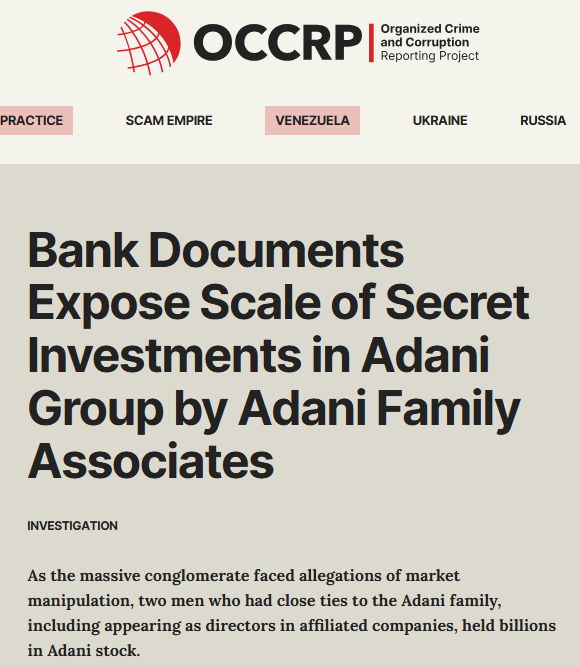
GENEVA / DUBAI – February 2026: In a bombshell revelation that could reignite global scrutiny on the Adani Group, newly uncovered banking documents have exposed that two businessmen with close ties to the Indian conglomerate’s founder held over $3 billion in Adani Group stock as recently as 2023. These investments were not only far larger than previously disclosed but also directly linked to several offshore hedge funds that appear to have acted as vehicles for hidden promoter shareholdings.
The documents, obtained by the Organized Crime and Corruption Reporting Project (OCCRP), shine a spotlight on the dealings of Nasser Ali Shaban Ahli, a UAE national, and Chang Chung-Ling, a Taiwanese citizen. Both men, who have had longstanding business relationships with the Adani family, have been involved in managing and trading Adani stock through various funds based in tax haven jurisdictions. This new exposure of their financial dealings is poised to further fuel the ongoing controversy surrounding the Adani Group, which has been embroiled in allegations of market manipulation, insider trading, and financial misreporting.
A Multi-Billion Dollar Revelation
Internal reports from REYL Intesa Sanpaolo, a Swiss banking giant headquartered in Geneva, reveal that as of February 2023, both Ahli and Chang held nearly $3 billion in stock linked to the Adani Group. This amount is significantly higher than the hundreds of millions previously reported in their holdings, stretching as far back as 2013, when both men were revealed to be linked with Adani-related firms.
The documents show that Ahli and Chang confirmed their investments in Adani stock through various hedge fund accounts held at Reyl Finance (MEA) Ltd., a Dubai-based subsidiary of the Swiss bank. In their written statements to the bank, they explained that their decision to make these significant investments stemmed from their personal and professional relationships with members of the Adani family, whom they trusted for their business acumen.
“We made these investments based on our relationship with the Adani family and their exceptional track record in business,” the associates reportedly told the bank, strongly denying any wrongdoing in the face of accusations made by the short-seller group Hindenburg Research earlier in 2023.
Controversy Reignites Amid Adani Group Scandal
The new revelations come as part of an ongoing investigation into the Adani Group, one of India’s largest conglomerates, which saw its stock market value plummet in early 2023 following an explosive report by Hindenburg Research. The U.S.-based short-seller accused the group of brazen market manipulation, claiming that its stock price was artificially inflated by insiders, including members of the Adani family and close associates.
In the wake of the report, Adani Group shares lost billions in value, only to rebound later after strong statements from the company and a favorable ruling from India’s Securities and Exchange Board (SEBI). While the Indian regulator cleared the company of wrongdoing in some aspects of the allegations, many investigations, including those into the Hindenburg claims, remain unresolved.
Despite Adani’s public denials, these new banking documents suggest that the influence of the Adani family’s inner circle over the stock market may have been far more pervasive than previously known. The revelations about offshore fund investments further raise questions about the extent to which the Adani Group’s leadership may have been involved in controlling the flow of capital to and from the company’s shares.
Swiss Investigations and Legal Implications
In addition to the OCCRP revelations, Swiss authorities are reportedly investigating Chang Chung-Ling on suspicion of acting as a “front man” for Adani Group investments. The Swiss Federal Prosecutor’s Office has confirmed that a criminal investigation is underway regarding money laundering and document forgery related to Chang’s role in facilitating offshore investments.
As of August 2024, Swiss authorities froze over $310 million in assets linked to Chang, although no formal charges have been filed. The investigation is closely aligned with previous reports by OCCRP, which uncovered evidence of hidden financial networks used by the Adani Group to boost stock prices while hiding the true ownership behind the shares.
In response to inquiries, Intesa Sanpaolo, the bank at the center of these revelations, declined to comment on the details of the case due to legal restrictions in Switzerland, Italy, and the UAE. However, the documents suggest that the scale of the investments was more extensive than initially believed, potentially involving substantial sums linked to multiple entities in tax havens.
Adani Group Denies Allegations, Cites Legal Compliance
The Adani Group has staunchly denied any wrongdoing in relation to these new revelations. A spokesperson for the company stated that any allegations of hidden promoter shareholding or insider coordination are “baseless”, claiming that the Adani Group adheres fully to Indian securities laws and international disclosure regulations.
Under Indian law, Adani Group representatives argued, the company has no control over public shareholders, nor does it have visibility into the specific sources of funds used by these investors. The spokesperson further pointed out that the company’s share purchases are openly disclosed in compliance with applicable laws and regulations.
“We have been vetted by regulators in India, and the Hindenburg claims have been adequately addressed. We believe our companies remain fully compliant with all disclosure and governance standards,” the Adani spokesperson added.
However, critics argue that these statements fail to address the complex and opaque financial structures behind the massive stakes held by Ahli, Chang, and other affiliates. With investigations still ongoing, both in India and abroad, the Adani Group faces mounting pressure to clarify its financial dealings.
Global Impact and Future Prospects
The case against the Adani Group has captured international attention due to its potential to reshape corporate governance norms in India and elsewhere. The involvement of offshore accounts and the role of high-net-worth associates in controlling stock market flows are likely to be areas of further scrutiny as both regulators and legal experts continue to analyze the magnitude of the scandal.
For now, the Swiss investigation remains in the spotlight, and any new developments in this case could significantly affect the Adani Group’s standing on the global stage. As the Indian conglomerate pushes back against allegations of market manipulation, both public and private inquiries into its financial dealings continue to expose the potential for deep-rooted conflicts of interest and lack of transparency in its operations.
Helvilux does not receive any subsidies or financial assistance from the governments of Luxembourg or Switzerland to support its journalism work. HELVILUX Media is an independent media outlet run by the non-profit organization Helvilux asbl in Luxembourg. To support our work with a donation, click here.