

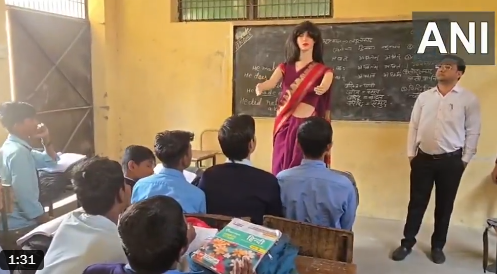
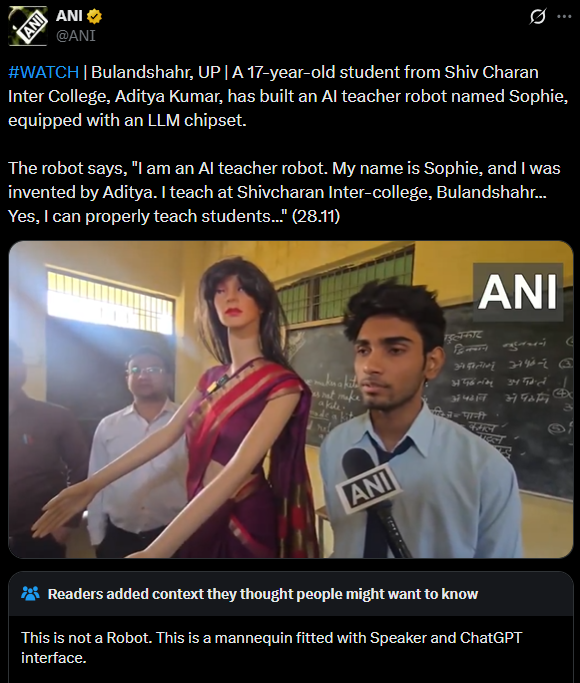
Uttarpradesh INDIA (Helvilux) – There is a special kind of magic in today’s India, an alchemy where a Bluetooth speaker taped to a mannequin wearing a saree can become, in the eyes of national news agencies, a “humanoid AI teacher powered by advanced LLMs.” If the world is wondering why India often becomes a viral punchline online, exhibit A has just walked into the classroom: Sofi, a ChatGPT-API speaker in a saree, celebrated by PTI, ANI, and their ever-enthusiastic ecosystem as if Boston Dynamics had just opened a branch office in Uttar Pradesh.
The inventor? A 17-year-old student, Aditya Kumar from Bulandshahr, who fair enough experimented with accessible tools and proudly built something on a shoestring budget. There’s no issue with the kid; the real comedy begins when the nation’s leading news agencies start marketing a talking mannequin as India’s new leap in robotics. The rest of the world, upon watching the video, wondered if this was a school project, a prank, or a Black Mirror episode the producers forgot to finish.
But no, this is simply today’s India, where technological literacy, media responsibility, and political realism frequently take turns disappearing.
The Great Con Vortex: From the “Chaiwala” PM to Indian Citizens
India has always been a land of great stories, but under Prime Minister Narendra Modi, the nation has mastered the art of branding fiction as national achievement. Since 2014, Modi’s tenure has been a continuous TED Talk of slogans, holograms, emotional manipulation, and media-managed perception, so much so that the line between innovation and improvisation has blurred beyond repair.
The “Make in India” era promised silicon valleys but delivered silicon-coated Chinese components with Indian flags slapped on top. Factories were inaugurated, cameras clicked, and the media clapped. Meanwhile, engineers worldwide quietly murmured, “Wait, isn’t that the same chip I bought on AliExpress for $3?”
The Sofi “humanoid” robot is simply the latest chapter in a long anthology of con artistry—except this time the con is so spectacularly obvious that even schoolchildren abroad are giggling.
A Nation Conning Itself ‘Now in Full HD’
India’s new sport isn’t cricket; it’s self-delusion.
A few months ago, a startup founder literally passed off manual labour as “AI automation.” Investors threw money, headlines followed, and only later did the world discover that the “AI” was a human behind a curtain, typing away like a tech-support version of The Wizard of Oz.
So when a Bluetooth speaker in a saree becomes the nation’s latest technological marvel, nobody in India should act surprised. This is just another entry in the ever-expanding catalogue titled “We Swear This Is Innovation, Please Believe Us.”
Media Without Brakes, Literacy Without Guardrails
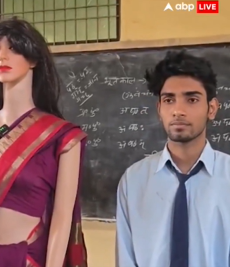
PTI and ANI, both regarded by many as government-friendly amplifiers rather than independent agencies, treated the mannequin story with the kind of reverence usually reserved for medical breakthroughs. The fact that no editor, producer, or journalist paused for even five seconds to ask,
“Wait, is this really AI?”
is, in itself, an award-worthy achievement.
India’s ranking of 151st in the Press Freedom Index suddenly looks less like a tragedy and more like a brutally honest description of how news works: Publish first, think later, correct never.
The real tragedy is that this isn’t an isolated incident, it’s a symptom of a nation where technology reporting has become a branch of political PR, and critical thinking is treated as a hostile foreign influence.
A Broken Education System Exposed by a Student’s “Invention”
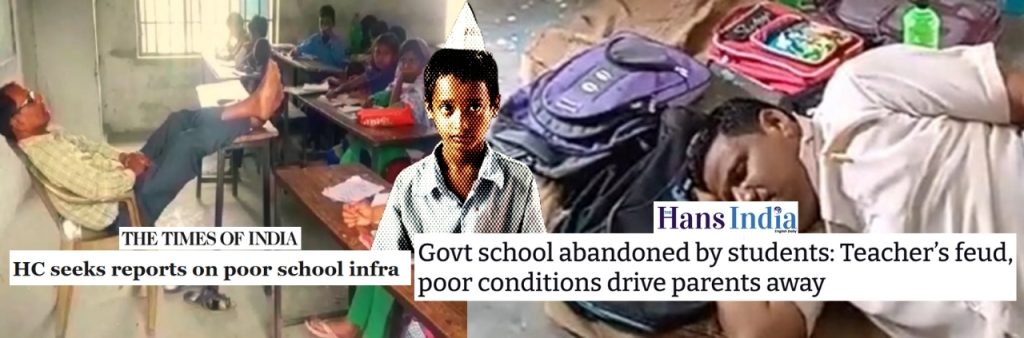
The Sofi mannequin unintentionally revealed a much deeper problem, one that has existed in India’s government-run schools for decades. Across countless villages and even cities, classrooms suffer not just from a lack of resources, but from a shortage of qualified, competent teachers. Reports and on-ground experiences repeatedly highlight cases where teachers struggle with basic arithmetic, cannot read English alphabets fluently, or lack the subject knowledge required to guide students. Yet these individuals somehow acquire teaching certificates and government placements, raising uncomfortable questions about the recruitment system itself.
In many rural schools, teacher absenteeism is so common that students often sit through entire days without structured lessons. It is precisely this reality that the young student who built Sofi may have witnessed firsthand the recurring absence, the indifference, and the vacuum where education should be. His project, however simple, reflects a hope that something anything could fill that void, even if only to engage or entertain students in the teacher’s absence.
Rather than heralding a breakthrough in robotics, this episode exposes the fragile state of India’s public education system. When a teenager feels compelled to build a stand-in “teacher” using a speaker and a chatbot, it’s not innovation that stands out, it’s the glaring failure of the system meant to educate the rising Indian generation in the first place.
PM Modi and his Degree

Let’s take a moment to look at the man whose governance style laid the foundation for this entire theatre: Narendra Modi. Over the past decade, his leadership has been characterized less by transparency and accountability, and more by spectacle, slogans, and meticulously curated imagery.
To begin with, Modi has never held a single unscripted press conference in his ten years in office, not during demonetization, not after major terror attacks, not in moments when the nation demanded clarity and direct answers. His distance from open questioning has now become a defining feature of his political persona.
Then comes the long-running mystery surrounding his educational qualification. For years, requests under the Right to Information Act have been stonewalled, rejected, or rerouted endlessly, with the relevant institutions refusing to produce verifiable records of his degrees. Ironically, a supposed certificate only began circulating widely after he became Prime Minister. Even more curious is that Modi himself once admitted on news cameras that he was “not very educated,” but after forming the government, a political science degree suddenly became part of the official narrative without ever being publicly authenticated.
Meanwhile, Modi’s struggle with basic English during global interactions has resulted in several viral and rather awkward moments. From exchanges with Joe Biden to numerous clips circulating on international social media, these instances have repeatedly drawn attention, not for diplomatic brilliance, but for confusion, miscommunication, and unintentional humor. His interactions with global leaders often resurface online as memes, making him a recurring subject of light-hearted ridicule worldwide.
A widely shared video of Modi attempting to recite the “a² + b²” formula remains a topic of discussion even today. The awkward delivery, “A quare plus B quare…” became emblematic for many observers, who saw it as a reflection of his uneasy relationship with academic knowledge and formal education. Rather than fading from memory, the clip continues to resurface as an example of how questions around his educational background persist in public conversation.
What emerges is a portrait of a leader whose political strategy rests heavily on controlled optics, emotional storytelling, and theatrical presentation. And the impact of this performative governance has deeply influenced the nation’s younger generation. When your Prime Minister becomes a masterclass in image over substance, it’s hardly surprising that young innovators imitate the same formula, creating things that look impressive, while relying on PR machinery to market them as revolutionary.
In such an environment, it becomes easier to understand how a Bluetooth speaker wrapped in a saree can be elevated to the status of a “humanoid robot” by national media outlets. After all, in today’s India, presentation has become more important than reality and nothing reflects that better than the leadership at the very top.
The West Looks at India and Sees “Potential” But Hasn’t Looked Under the Hood
Western right-wing parties, policymakers, and investors love to romanticize India as the “next global superpower.” They point to its booming population, rising GDP figures, and the institutional framework inherited from the Nehru era structures that, ironically, still hold the country together despite decades of political wear and tear. But after 2014 in the BJP regime it’s just become a polished narrative, one that flatters India and reassures foreign observers who want to believe the country is destined for greatness.
But the enthusiasm often comes from a distance. Most of these admirers have never bothered to lift the hood and examine the machinery actually powering the world’s “fastest-growing democracy.” If they did, the picture would look far less glamorous.
Beneath the surface lies a collapsing education system that prioritizes rote learning over critical thinking and celebrates superficial tech demonstrations as breakthroughs. The media landscape is saturated with outlets that treat truth as optional and government press releases as journalism. Politics increasingly resembles reality television, where theatrics overshadow governance and narrative matters more than results. The bureaucracy once India’s pride is now tangled in inefficiency, struggling to deliver even basic administrative functions in a modern world. A country where even the name of a Brazilian model can appear on multiple fake voter lists, allegedly used in electoral fraud cases, while the Election Commission of India remains silent and the opposition exposes such issues daily raises serious questions about how individuals who were never genuinely chosen by real voters manage to enter public office.
And perhaps most telling of all, citizens are being applauded not for genuine innovation but for performative attempts that merely look innovative. Image has replaced substance; presentation has substituted for progress.
If this structural decay continues unchecked, the fallout won’t remain confined within India’s borders. A nation of 1.4 billion drifting on illusion rather than infrastructure poses consequences for global markets, global diplomacy, and global stability. The world may see potential, but unless it understands the reality beneath the façade, that potential may turn into a very different kind of global impact.
Not Against the Student, But Against the System
The Sofi mannequin isn’t a scandal because a 17-year-old used ChatGPT. That part is completely understandable. Young students experimenting with accessible technology is not only normal, it’s commendable. The issue doesn’t lie with the teenager who built a simple project with enthusiasm; it lies with the system that took that project and turned it into a national spectacle.
The real scandal is that major news agencies rushed to portray this basic setup as a groundbreaking technological revolution. State authorities jumped in to celebrate it as a sign of India’s innovation prowess, proudly promoting it without the slightest understanding of what artificial intelligence actually is. Instead of seeing Sofi as a school-level demonstration of a language model integrated with a speaker, it was sold to the country as proof that India is now a global AI powerhouse.
When a ₹25,000 Bluetooth speaker wrapped in a saree becomes a symbol of national scientific achievement, it reveals something deeply troubling. It shows that the bar for innovation has fallen so low that almost anything, so long as it looks good in a video clip, can be transformed into patriotic technological propaganda. The tragedy is not the student’s creation, but the institutional hunger for headlines so desperate that even basic tinkering is inflated into evidence of superpower status.
While several countries are racing ahead in artificial intelligence, India remains tangled in endless debates over caste identities and religious divisions. At a time when national priorities should be aligned with science, research, and technological progress, public discourse is still dominated by social fractures rather than future-oriented development.
The media, instead of acting as a responsible watchdog, often gravitates toward sensationalism or political amplification. Scandals involving public figures, including those facing allegations of misconduct, rarely seem to hinder political careers. Leaders embroiled in controversies continue to get elected, cycle after cycle, while voters who endure the consequences of poor governance often return to the same choices during elections. In such an environment, expecting rapid progress toward “developed nation” status becomes increasingly difficult.
Other global players have already built sophisticated AI ecosystems: the United States has models like ChatGPT, China has platforms like DeepSeek, and numerous other countries are advancing in robotics, machine learning, and scientific innovation. Meanwhile, India’s mainstream online trends often revolve around astrology apps, superstition-based content, and myth-driven narratives that routinely overshadow logic, inquiry, and scientific temperament.
In a world where technology is evolving at breakneck speed, India’s fixation on outdated debates and unproductive political cycles raises uncomfortable questions about its readiness to compete on the global AI stage.
In the end, Sofi isn’t a reflection of Indian youth, it’s a mirror exposing the flaws of a system far more invested in appearance than in actual progress.
When a Nation Chooses Spectacle Over Substance
Recently The International Monetary Fund’s annual review has given India’s national accounts statistics including Gross Domestic Product (GDP) and Gross Value Added (GVA) a grade of ‘C’, the second lowest rating. Accourding to the IMF, this grade means the data available ”have some shortcomings that somewhat hamper surveilance”.
India today stands as a remarkable case study in what unfolds when a country becomes more captivated by performance than by policy. The rise of a tea seller to the position of Prime Minister is, no doubt, a story rich in mythology and symbolic appeal. But mythology does not govern nations, systems do. And the gap between the narrative and the ground reality has increasingly turned into an international spectacle.
The Sofi mannequin story is not, in any sense, a mockery of the student who built it. His effort is perfectly legitimate. What it truly represents is a mirror, the one reflecting a nation that has spent the past decade entranced by optics, slogans, and nationalistic theatre while its foundational institutions slowly weaken. It exposes a culture where presentation consistently outweighs performance, and where superficial innovation is celebrated more loudly than meaningful progress.
If this trajectory continues unexamined, India won’t need external forces to deceive it or undermine its credibility. The country will simply keep misleading itself, convinced by its own grand narratives while drifting further from the substance required to sustain genuine advancement.