
Zurich Limmat Prosecutor Accused of Shielding Police Misconduct

Zurich (Helvilux Media)- Switzerland is admired worldwide for its stability, neutrality, and strong democratic institutions. Yet, behind this polished image, an uncomfortable reality is increasingly coming to light. Growing concerns about bias, mishandled investigations, and systemic loopholes within the Swiss justice system, particularly within the powerful office of the public prosecutor in canton of Zurich.
Recent cases, reports, and testimonies gathered by Helvilux Media reveal alarming patterns across multiple cantons. But one case from Zurich involving allegations of unlawful police actions, retaliation, missing personal belongings, and prosecutorial protectionism has become a striking example of what critics describe as a “broken system designed to protect officials, not citizens”
The Public Prosecutor: Switzerland’s Most Powerful Figure in Criminal Justice
Before we start the whole story lets understand how public prosecutor is an important factor in Justice system in Switzerland. Unlike many countries, where power is distributed among police, prosecutors, and judges, Switzerland concentrates enormous authority in the hands of the Staatsanwalt (public prosecutor). Under the Swiss Criminal Procedure Code (StPO), in effect since 2011, the prosecutor simultaneously functions as an Investigator, Supervisor of police operations, Charging authority and Final decision-maker in 90–95% of criminal cases. According to federal statistics (2024) 92% of criminal cases end with a Strafbefehl (summary penalty order) issued solely by the prosecutor. Only 4–5% ever reach a full trial. Around 3–4% are dismissed without charges. Many minor cases are not even opened. This means that, in practice, the prosecutor often acts as judge and jury with minimal judicial oversight. Given this sweeping authority, allegations of bias or misuse of power within a prosecutor’s office carry serious implications for public trust and rule of law.
A Family in Zurich Takes on the System
In Zurich one family has accused the Public Prosecutor Office Zurich Limmat’s staatstanwalt (Public Prosecutor) of mishandling their case and protecting a police officer who allegedly abused his authority. Their story reflects deeper systemic gaps and highlights how difficult it can be for ordinary residents to fight back.
Unlawful Entry by Swiss police Without a Warrant
According to video and document evidence reviewed by Helvilux Media, a Kantonspolizei Zurich officer entered the residence twice of a Zurich resident woman, a mother of two children, without presenting any warrant or legal documentation and conducted an illegal search in the year 2024. With respect to data privacy law the image as been blur and voice frequency has been changes.
Accused police officer justification was a letter from Migrationsamt Kanton Zürich stating that an individual let say “X” had lost residency rights, absconded and should be expulsion from Switzerland. However, no legally valid search order or supporting documents were shown to the homeowner before conducting the search.
The victim had a CCTV camera installed inside her house and also recorded the incident on her phone. Footage shows the officer forcing entry despite her objections.
Not just that but also the officer allegedly attempted to pressure her into deleting the recordings, warning that he would file anzeige (case) against her if she refused. She declined citing her knowledge of Swiss law and her work as an human right activist.
Another officer accompanying him intervened and respected the police protocol before her phone could be taken by the accused police officer.
Retaliation: False Accusation Against the Victim
The next day, the same police officer filed a complaint accusing the woman of illegally filming the police while they were doing their duty. The Stadtrichteramt Zürich (Zurich City court) later dismissed the accusation, confirming she had acted within her legal rights.
“This shows how some Swiss police officers, just to satisfy their ego and to put psychological pressure on victims so that they in fear will delete the video evidence use the tactics and also shows how they can file a wrong complaint to authorities by misusing their official police power” the victim told Helvilux Media.
Let see what the rules says for lawful filming the police in Switzerland,
DSG Article 30 permits private video surveillance for security if it’s proportionate, confined to one’s own premises, and noticeable, but this does not extend to banning citizen recordings of public police duties, which fall under broader freedoms of expression and information enshrined in the Federal Constitution (Articles 16 and 17). That means recording police officers while they are doing their job is not illegal.
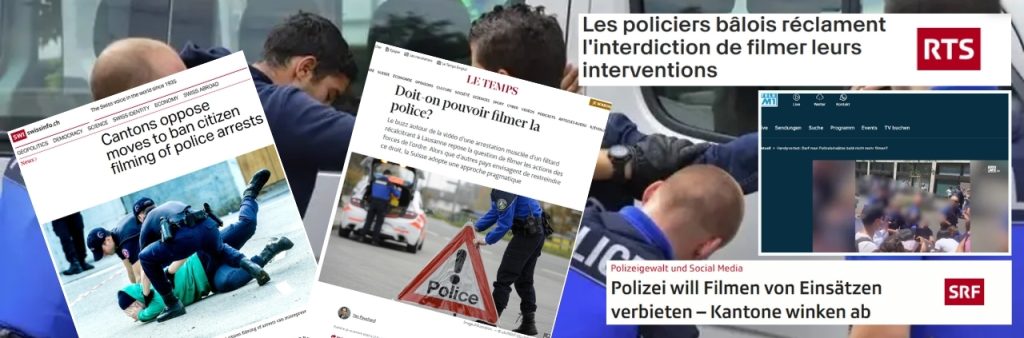
Yet, as reported in past several times by Swiss media outlets like the NZZ am Sonntag, RTS and SRF in mid-2023, police unions have pushed for restrictions on such filming during arrests or demonstrations, arguing that selective clips shared on social media misrepresent their work and violate officers’ image rights, portraying them as the “true victims” threatened by “gawkers and activists.” On November 19, 2020, the daily Le Temps published the article Should it be possible to film the police?. Ville de Geneve also posted an article Do we have the right to film or photograph police officers on duty? in their website. Tele1m.ch digital media also published an article Handyverbot: Darf man Polizeieinsätze bald nicht mehr filmen? related to this topic.
This stance misinterprets the law by overemphasizing privacy protections intended for intimate or non-public spheres over the overriding public interest in transparency, leading officers on the ground to routinely issue commands like “Stop filming and delete it now,” even in routine public interactions, under threats of device confiscation or charges for obstructing duties, as noted in Basel-Stadt police guidelines and court cases like the 2019 Solothurn ruling and in this recent case of Zurich city.
The year 2023 incident when Swiss cantons came out against the idea of a general ban on public filming of police work, which some forces want. Click to read the news which was published by Swissinfo.ch Media.
Therefore, a growing tension between citizens’ rights to document police actions and officers’ demands for privacy has led to frequent confrontations time to time, where victims of alleged misconduct often cease recording despite being legally entitled to continue, as highlighted in recent debates over the Swiss Civil Code (ZGB) Article 28 and the Federal Act on Data Protection (DSG) Article 30. Under ZGB Article 28, which safeguards personality rights by prohibiting unauthorized attacks on privacy, honor, or image without consent while allowing courts to balance public interest against private concerns, filming police in public spaces for evidence or accountability purposes is generally permissible, especially when it serves to expose potential abuses rather than harass individuals.
Missing Belongings After Illegal Search
Following the forced entries, the victim reported missing belongings (theft case) including her wallet, ring, and cash and filed a complaint with both the police and her insurance company.
She alleges that the theft occurred during the unauthorized police entry.
Why, especially, sometimes Swiss police avoid using body cameras is a big Question?
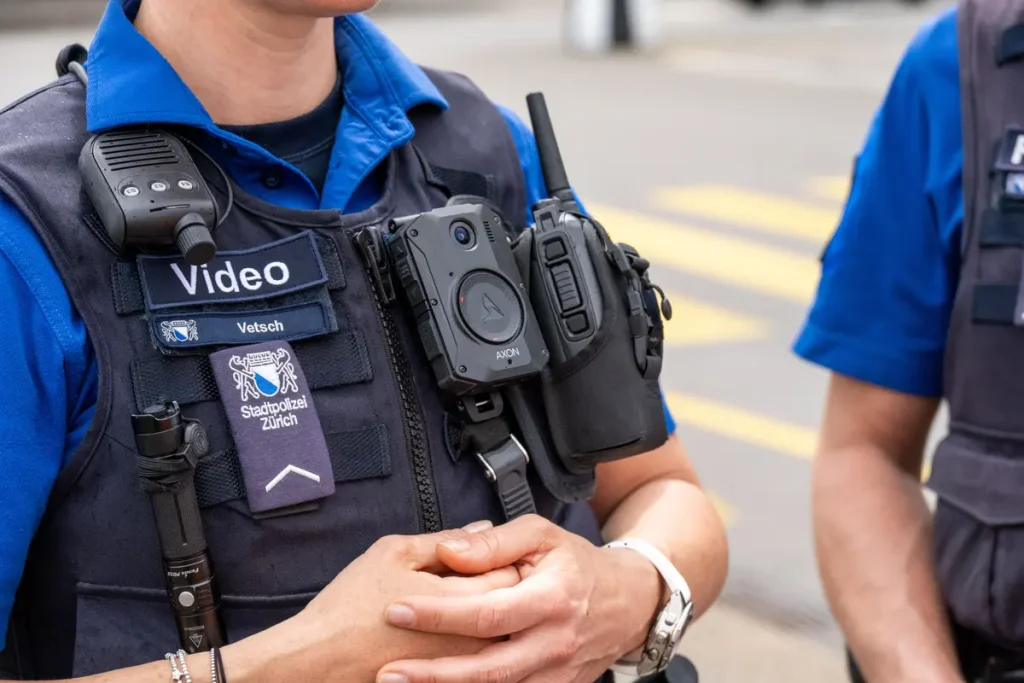
In the Canton of Zurich, both cantonal and city police officers are generally equipped with body cameras. These devices are intended to be activated during incidents to ensure transparency, enhance accountability, and provide objective evidence in case of later investigations.
Body-worn cameras have been introduced across several Swiss cantons since 2018, with further expansions between 2019 and 2020, precisely to improve policing standards and protect both officers and the individuals they interact with. This raises a significant question: why was the officer involved in this case not wearing a body camera on that particular day? Had the device been in use, it could have clarified the disputed claim regarding the victim’s belongings and whether anything was taken or not. On the other hand, the absence of a body camera, combined with the reported threat demanding deletion of video evidence, removes an important layer of accountability that could have worked in favors of the officer if their conduct had been proper.
This case demonstrates how the failure to wear a body camera can lead to serious consequences, uncertainty, and mistrust, underscoring the importance of consistent and mandatory use of body-worn cameras in policing.
Charges the Police Officer Could Face Under Swiss Law
Based on court files, police reports, city of zurich court dismissed order and the Migrationsamt of canton Zurich letter, the officer’s conduct potentially falls under several criminal articles as following –
Art. 312 StGB – Abuse of Official Authority (Missbrauch der Amtsgewalt) for which Up to 5 years imprisonment for officials who misuse their power to harm someone or obtain unlawful benefit.
Art. 303 StGB – False Accusation (Falsche Anschuldigung) for which Up to 3 years imprisonment for knowingly making false accusations. Aggravated penalties apply if committed by a public official.
Art. 186 StGB – Trespassing (Hausfriedensbruch) in which Up to 3 years imprisonment for unlawfully entering someone’s property, more severe when done by an official.
Past Swiss Federal Court decisions (6B_846/2019 and 6B_117/2021) have convicted prosecutors under related provisions for similar misconduct.
It is also important to note that when an ordinary Swiss citizen or a foreign resident in Swiss soil makes a false accusation, they typically face legal consequences, and courts often issue convictions in such cases. In this situation, however, no comparable action appears to have been taken against the police officer involved. This discrepancy is what many find concerning, raising questions about equal treatment before the law and the impartial application of justice.
Given these legal frameworks, the victim expected a thorough and impartial investigation and justice. Instead, she says she encountered systemic obstruction by the Swiss judiciary system.
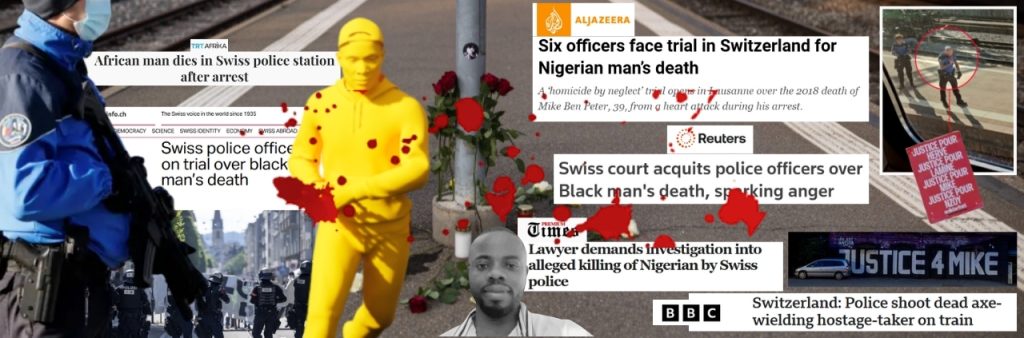
A Long Trail of Police Abuse in Switzerland ; Lives Lost, Cases Buried
There is a long and troubling history of police abuse in Switzerland, cases involving racial profiling, excessive force, medical neglect, and even deaths in custody. Many victims never received justice, and numerous investigations were quietly dismissed or buried over the years. These patterns become even more alarming when seen alongside the chronic lack of prosecutorial oversight. Helvilux Media has published a detailed report documenting these cases, which can be read here, A Long Trail of Police Abuse in Switzerland ; Lives Lost, Cases Buried
A “Broken System”: Delays, Missing Files, and Dismissed Rights
The victim described a long struggle to obtain relevant case files (Akten) from various authorities. She alleges a “systemic pattern of blocking access to information,” forcing her to file multiple appeals including to the Supreme Court of Canton Zurich and Federal court of Switzerland.
As the fight is against the broken system in Switzerland therefore not a single lawyer shows interest to represent her in court. Despite lacking legal representation, she prepared and filed all petitions herself.
“The Swiss law system is so broken that it is not made to give justice but to protect the corrupt officers and criminals who break the law” she said to Helvilux Media.
‘Neither the cantonal Supreme Court nor the Federal Court showed interest in appointing me a lawyer from the state even when I am eligible for that to protect my rights and to get justice’ she added.
Prosecutor Zurich Limmat: The Controversial Decision
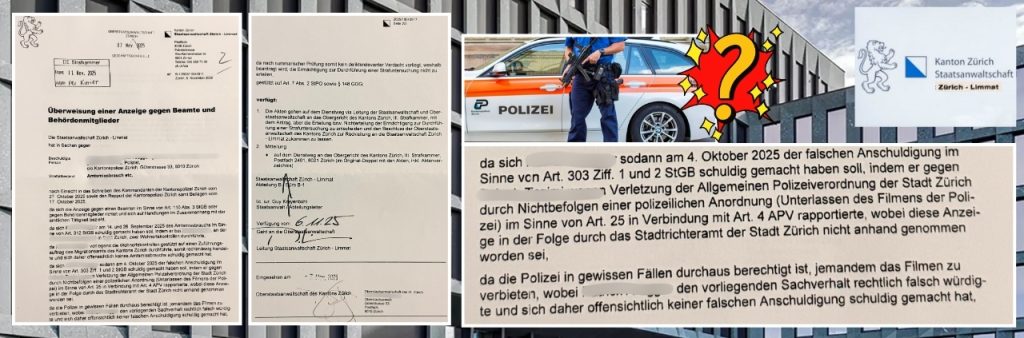
On 5 November 2025 (Ref. B-1/2025/10043917), Staatsanwalt lic. iur. Guy Krayenbühl of Abteilung B, Büro B-1, issued an order concluding: Click here to see the order copy.
The police officer did not commit a false accusation, as he “misjudged the legal situation.” Police may “in certain cases” prohibit filming. A “summary review” found no suspicion relevant to an offense. Therefore, no authorization would be granted to open a criminal investigation.
This rationale has raised serious questions among legal observers. The evidence including CCTV footage, recordings, and administrative documents appears to contradict the prosecutor’s findings.
Critics argue that the prosecutor’s office and public prosecutor is defending the officer instead of applying the law objectively, despite its legal obligation under Art. 6 StPO to collect both incriminating and exculpatory evidence.
Experts Speak: “Police and Judiciary Are Not Working Properly in Switzerland”
A veteran journalist and member of reporters without borders told Helvilux Media:
“Basically Switzerland is far better maintained than other European countries, but when it comes to policing, some Swiss police officers are not interested in respecting protocols. The problem is not just the police but the judiciary system in Switzerland is also not working properly, and it’s broken. Sad to say this Harsh reality”
He added: “The system does not want to accept that it is broken. Internal improvement is necessary for a better tomorrow. If not improved now, it will be a challenge not only for foreigners but also for local Swiss citizens.”
He described Art. 110 para. 3 StGB as a major loophole, effectively shielding public officials from swift criminal action.
According to him, this flaw enables delays that deny victims justice:
‘The legal framework is structured in such a way that public prosecutors cannot act quickly when the accused is a government official. During these prolonged delays, victims often lose hope or face pressure, and as a result, countless cases end up buried in files’
Case against public prosecutor for being biased
With the lower prosecutor’s office refusing an investigation and the matter with the Supreme court of canton Zurich, the separate case against the public prosecutor of Zurich Limmat is now at the Oberstaatsanwaltschaft des Kantons Zürich. Their decision will test whether Switzerland’s oversight mechanisms still function when allegations are made against police and prosecutors themselves.
Helvilux Media requested official comments from the Public Prosecutor Office Zurich Limmat Office B-1. As of publication time, they said via email as following,
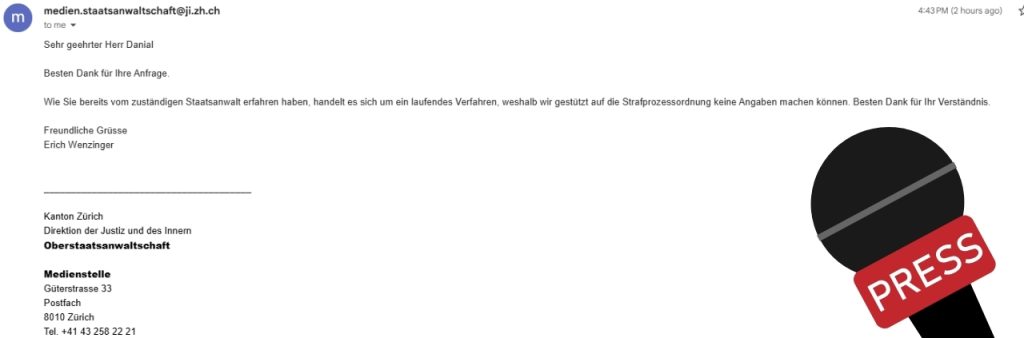
‘this is an ongoing procedure, which is why we are based on the Code of Criminal Procedure. cannot provide any information.’
Any statement provided later will be added for Helvilux’s readers.
A Troubling History: When Swiss Prosecutors Themselves Faced Corruption Allegations
Switzerland’s current controversy in Zurich does not stand alone; it unfolds against a broader backdrop in which prosecutors and justice officials themselves have faced serious corruption, misconduct, and accountability failures over the past two decades. From the secret and unlawful meetings between former Attorney General Michael Lauber and FIFA President Gianni Infantino, to the informal Telegram chats that compromised data during the Operation Car Wash investigations, to the long-delayed prosecution in the Seco bribery scandal, Switzerland has repeatedly struggled to hold its own authorities to the same standards expected of ordinary citizens. Additional cases, such as the disputed Zurich Langstrasse police shooting, wrongful convictions through overused Strafbefehle, Geneva’s controversial Addax Petroleum settlement, and the slow response to ABB’s South Africa bribery affair, collectively paint a troubling picture: when powerful figures within the justice system cross ethical boundaries, oversight becomes inconsistent, slow, or disappears entirely. These patterns make the present case in Zurich particularly significant, raising fresh concerns about whether Switzerland’s institutions are truly willing or able to investigate themselves. Detailed news can be read here A Troubling History: When Swiss Prosecutors Themselves Faced Corruption Allegations
Switzerland’s international reputation for fairness is being challenged by rising allegations of prosecutorial bias, unchecked police misconduct, and legal loopholes that delay justice. The Zurich case illustrates how difficult it can be for ordinary residents and also for Swiss citizens, even those who know the law to hold officials accountable.
Whether the higher authorities acknowledge the evidence, or the case becomes another file gathering dust, may signal the direction of Switzerland’s justice system for years to come.
(Helvilux Media conducts thorough, evidence-based investigations in accordance with the Helvilux Press Ethics Code. Should any party believe this report to be inaccurate or defamatory, they are free to pursue the appropriate legal channels. All necessary contact and editorial details for formal proceedings can be found in our imprint.)