
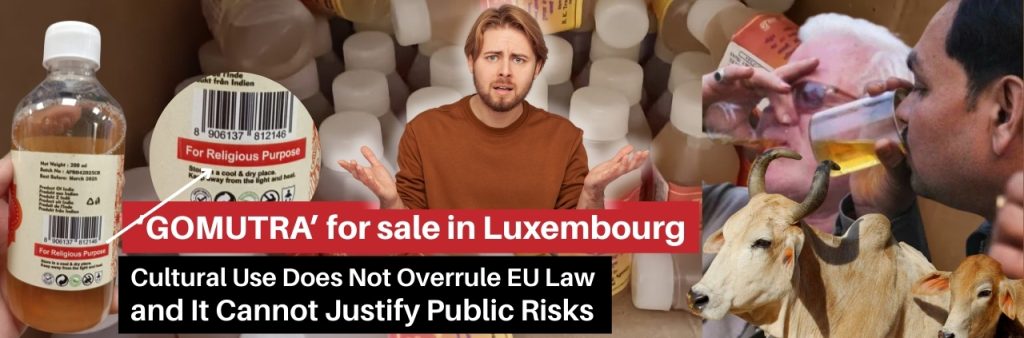

Luxembourg (Helvilux) — A recent investigation by the Helvilux Media investigative team has uncovered that several Indian grocery shops in city Luxembourg and all over the country operated by members of the Indian and Nepali community, have been selling cow urine in sealed containers imported from Gujarat and Mumbai city of India without meeting EU import formalities or compliance standards. This practice poses a potential public-health risk and is strictly prohibited under EU law.
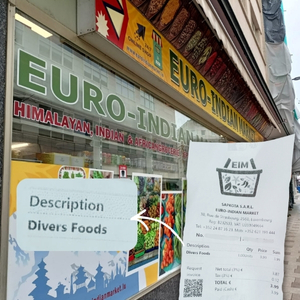
Recently, the Helvilux Investigative team visited several Indian grocery shops and discovered that cow urine is being sold in most of them. Near Luxembourg Gare, an Indian shop named EURO INDIAN MARKET at 38, Rue de Strasbourg, L-2560 Luxembourg was found selling cow urine for 3.99 EURO for a 50 ml bottle. The container indicates it is imported by GFT France S.A.R.L. The packaging displays a price in Indian rupees (20 Rs for 50 ml), and it is packaged by Anand Enterprises, Gujarat, and marketed by B. K. Trading Agency, Mumbai INDIA. The packaging claims that the cow urine is collected from Gujarat’s authentic cows.
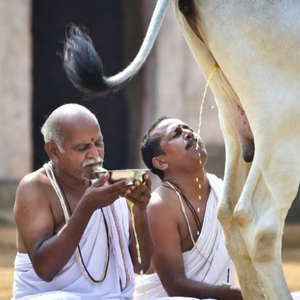
In Hindi, it is written as follows: GOMUTRA – It is considered sacred. It is useful in all kinds of worship, rituals, materials, temples, and commercial establishments, etc. Every Hindu uses cow urine (gomutra) daily in the morning and evening.
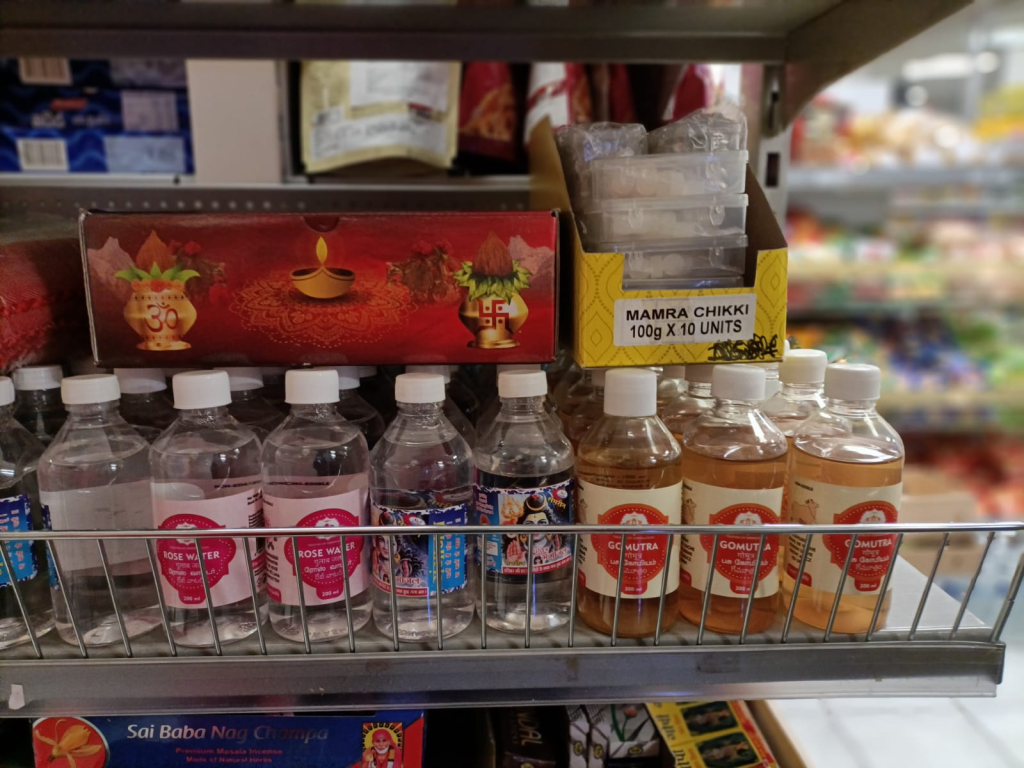
The Helvilux investigative team also visited another Indian grocery shop in Luxembourg city, named ‘Indian Spice Bazar’ situated at 2 Rue du Fort Wallis, 2714 Gare Luxembourg. Here, we found that cow urine was being sold in a 200 ml bottle labeled as “Gomutra.” This 200 ml bottle was sold for 2.50 euros. Shockingly, the product did not provide any information about where it was produced or who imported or marketed it. It was simply labeled “Product of India”.
Another concerning issue is the invoicing practice in these ethnic grocery stores. The receipts for the cow urine are labeled as “Divers Foods” instead of “Cow Urine.” Therefore, is this cow urine being sold for religious purposes, or is it being marketed as a food product? Are these religious claims on the packaging just a way to facilitate import and sale as a food product? Also we observe that, Sometimes when items can’t be scanned or found within a retail sorting system – it will be entered manually under a different name or a default item name will be used alongside an internal note made by the shop to adjust when inventory counts take place. This alerts the shop owner than something went wrong in terms of properly recording the items sold (for his inventory purposes) so he needs to manually change it later. These are some of the questions now circulating after observing these practices.
Helvilux has contacted the relevant authorities on 29 November to urge a comprehensive inspection of all Indian grocery shops in the country ensuring that such loopholes in import and customs are not exploited to import cow urine into Luxembourg under the guise of cultural or religious tradition. European member states, including Luxembourg, operate under strict and unified food-safety and medicinal-product regulations that do not permit the kinds of regulatory gaps or informal practices sometimes seen elsewhere. A lax attitude toward food and other regulation sometimes seen in certain markets outside the EU toward unregulated animal-based products like in India and some other third world countries. This ground report underscores the urgent need for enforcement and public awareness in Luxembourg to ensure that such violations cannot take root.
The way cow urine is being imported into Luxembourg, either directly from India or via Belgium or France under different company names, raises concerns about its legitimacy. If this kind of cow urine illegal importation is happening within the EU, what happens if a disease outbreak occurs because of it? Who will be held responsible for that?
The consumption of cow urine, which has been promoted in Ayurveda for its supposed health benefits, raises significant health concerns. Studies from the Indian Veterinary Research Institute (IVRI) have shown that cow urine contains harmful bacteria, including Escherichia coli, which can cause stomach infections. Click here to read the report. The lack of regulation in the Ayurveda industry has led to the widespread use of substandard products, with reports revealing that nearly 40% of Ayurvedic items tested by the Indian government were found to contain toxic substances like heavy metals, insecticides, and steroids.
For some Indian (both from north and south asian) and Nepali communities, cow urine carries religious or traditional significance, especially among strict Hindu believers. It’s used in household rituals, agricultural practices, and certain streams of Ayurveda. However, some interviewees emphasized that these beliefs are not universal and that many individuals from those communities do not follow such practices. They emphasize to Helvilux Media that the belief in cow urine as medicine is not rooted in science but in cultural myths that spread most easily in rural regions where education is limited. Several interviewees noted that some individuals become so emotionally attached to religious symbolism that they will go to extreme lengths to justify these beliefs, even claiming medicinal value for cow urine or cow dung without any credible scientific support.

Furthermore, political endorsements of Ayurveda, including the promotion of cow urine during the Covid-19 pandemic, have raised concerns about its scientific validity and the potential harm it causes to public health. Read this. Critics argue that Ayurveda, especially when commercialized without proper scientific backing, is more of a business venture than a legitimate healthcare practice. Click to read the report.
Not just cow urine, but also the import of cow dung is a significant problem in Europe and other Western countries (most of the time illegal import). If this issue is not properly addressed, there could be an outbreak of foot-and-mouth disease, which could impact thousands of agricultural businesses and farmers across Europe.
Regarding cow urine and cow dung smuggling issue, a few years ago, U.S. Customs officials issued notification that Indian travelers stop carrying cow dung in their luggage. On May 12, 2021, a report was published by Vice Media highlighting this concern. Click to read the report.

Now, in 2025, the problem persists and has even spread to European countries. The legal framework to address such issues is provided by Regulation (EU) 2016/429 (“Animal Health Law”), which mandates that each EU member state, including Luxembourg, is responsible for ensuring compliance with these regulations.
Helvilux Media has submitted a detailed report, invoice, photographs and evidence to the responsible authorities and has requested strict action to prevent the illegal sale of cow urine and cow dung in Luxembourg, so as to avoid a potential foot-and-mouth disease outbreak in Luxembourg and other EU member states.
In Luxembourg, Up to 860 dairy farms (nearly 48% of total farms) could be directly affected, as FMD primarily impacts cloven-hoofed animals like cattle (180,530 heads) and sheep (~20,000–25,000). Over 70% of farms (est. 1,260+) hold livestock (cattle, pigs, sheep) as per Eurostat holdings data could be at risk if this illegal cow urine import would spread disease. An outbreak could halt exports (150 million liters milk/dairy annually to Germany, France, Belgium), leading to €100–150 million losses (40–60% of sector output). With agriculture on 53% of land (grasslands dominant), recovery could take 6–12 months, impacting 2,800 jobs and EU supply chains.
Is the Cow Really ‘Holy’ for Indians? The Reality Behind the Reverence
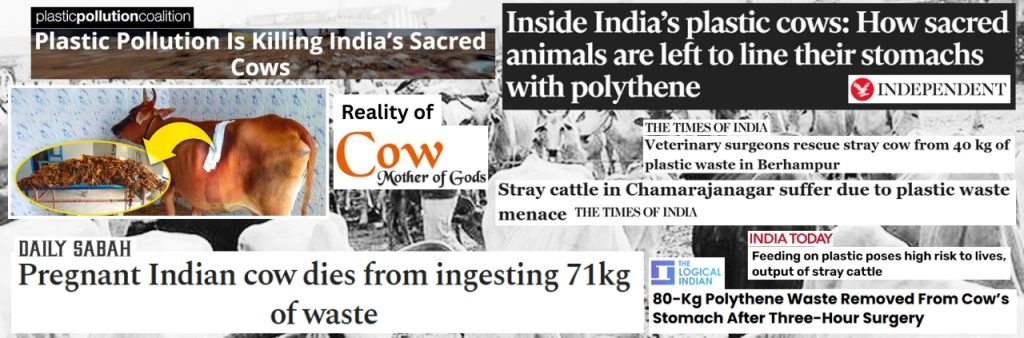
The claim that cows are sacred and revered as “mothers” in Hinduism is central to the beliefs of many in India. However, the ground reality presents a grim and troubling contrast. A recent report, published on March 25, 2025, in the Times of India, highlights a disturbing issue in Mysuru, Karnataka, where stray cattle, particularly cows, are suffering from the effects of plastic waste. Despite a ban on single-use plastics, the situation remains dire. In the past three months alone, as per local indian media report and hospital reports indicate that five cows and seven goats have undergone surgery to remove plastic waste from their stomachs. Hospital records show that two to four such cases occur every month, reflecting the widespread and growing problem of unscientific plastic disposal, which is severely impacting stray cattle.
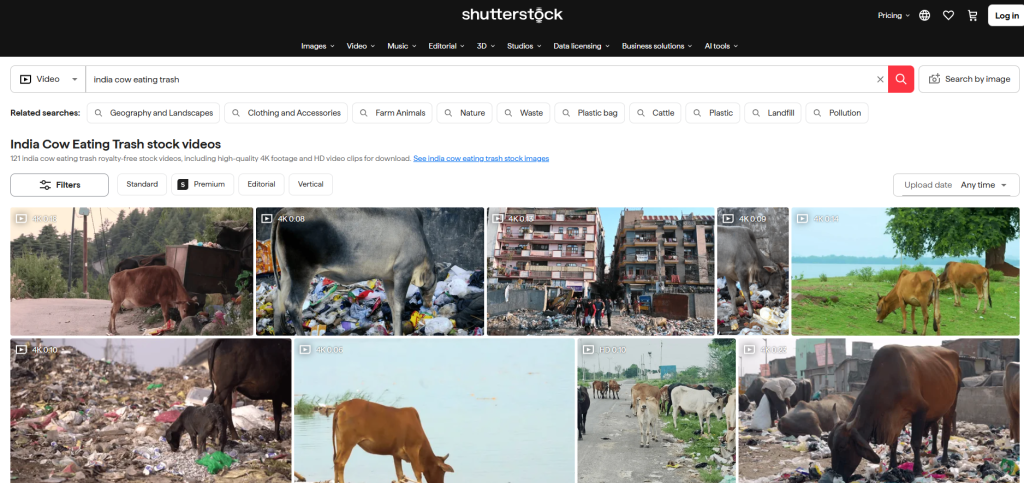
This crisis is not limited to Karnataka but extends across India. The issue of cattle dying from ingesting plastic has been ongoing for over a decade, yet the situation remains largely unchanged. While there is no official nationwide data on how many cows die annually due to plastic consumption, reports from 2021 revealed that veterinarians had to extract a staggering 71 kg of plastic, nails, and other waste from the stomach of a pregnant cow. Tragically, both the cow and her calf died as a result. Uttar Pradesh, a state known for its large population of “Gau Rakshaks” (cow protectors), records over 1,000 cow deaths each year due to the ingestion of polythene and plastic, according to reports.

If cows are so sacred and revered in India, why are they being left to suffer and die in such inhumane conditions? International tourists and YouTubers who have witnessed this firsthand during their visits to India have highlighted the grim reality of stray cows consuming plastic waste. They paint a far more troubling picture of the so-called “holy cow” nation, revealing the stark contrast between the idealized image of the cow as a revered mother figure and the harsh reality on the ground.
The situation demands urgent attention and action. It calls for serious reflection on how society treats these animals, whose welfare is crucial not only to their survival but also to the ethical and cultural values that India claims to uphold.
When Devotion Gets Messy: Inside the Kuruba Cow-Dung Celebration

Recently, a YouTuber from the United States visited a village and shared a video of his unusual experience, completely covered in cow dung, during the local festival. This brought the Kuruba community’s “Gorehabba” cow-dung festival into the spotlight. In a village on the Tamil Nadu–Karnataka border, the Kuruba shepherd community celebrates this annual event the day after Diwali. Hundreds of villagers gather to throw fresh cow dung at each other in devotion to Lord Beereshwara Swamy, believing it brings blessings, health, and prosperity. Rooted in centuries-old panchagavya tradition, the ritual emphasizes faith, community, and respect for cows, highlighting a cultural practice very different from the illegal and unregulated sale of cow dung and urine in Europe.
‘Gomutra’ for The Public, Chemotherapy for The Powerful
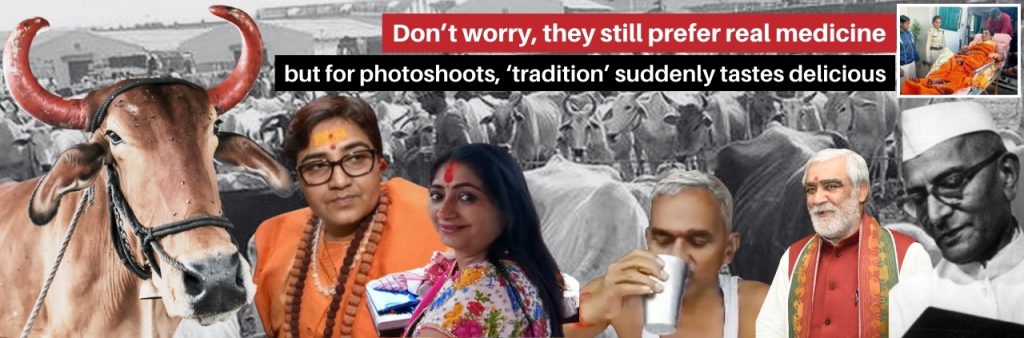
This pattern of cow urine as holy is amplified by public statements from certain Indian politicians and religious organisations. Members of the ruling Bharatiya Janata Party (BJP), a political party that publicly positions itself as a defender of Hindu culture, have repeatedly promoted cow urine as a cure-all, even while privately relying on modern medical care.

In 2019, a Member of Indian Parliament Pragya Singh Thakur from the same rulling BJP party claimed that drinking cow urine cured her breast cancer and later said that daily cow urine ‘gomutra’ consumption “purifies the body and lungs” to prevent COVID-19. Click here to watch the video. Yet medical records, indian news and public statements confirm that she underwent chemotherapy and other standard treatments at major hospitals before going into remission, and she continued to rely on allopathic medicine afterward. Click here to read the report.
Similarly, BJP MP Surendra Singh, in 2020, promoted cow urine and cow dung as treatments for COVID-19 and cancer, citing examples from Gujarat. He publicly supported anti-allopathy rhetoric from figures like Baba Ramdev, even as BJP lawmakers around him were hospitalized with COVID-19 and treated with modern medicine. Click to read the report.
Another BJP MP, Suman Haripriya, made comparable claims in Assam’s state assembly during the 2020 pandemic, suggesting that cow urine ‘gomutra’ and dung could fight the virus. Her comments came at a time when Assam’s own BJP ministers were depending on ventilators, Remdesivir, and other allopathic interventions. She simultaneously endorsed conventional health advice such as Vitamin D intake. Click to read the report.
More surprisingly, Ashwini Kumar Choubey, then Union Minister of State for Health and Family Welfare promoted cow urine research for cancer treatment in 2019. He referenced former Indian Prime Minister Morarji Desai’s well-known support for urine therapy. Yet during the COVID-19 crisis, Choubey oversaw mass vaccination campaigns, hospital expansions, and the distribution of allopathic drugs all while publicly mentioning cow urine ‘gomutra’ as a potential area of the Ministry of AYUSH in India. Click here to read the report.
Even Former Prime Minister of India Morarji Desai himself, who famously advocated drinking urine in a 1978 CBS interview, relied on conventional hospital care in his final years, including treatment for prostate and age-related illnesses. Click here to read the report.
These contradictions promoting cow urine as a miracle cure while personally relying on modern medicine illustrate how political messaging in India often mixes religion, tradition, nationalism, and public health narratives. Despite this inconsistency, a segment of the Indian diaspora around the world still believes that cow urine or cow manure have medicinal value, even though scientific bodies across India, Europe, and the United States have repeatedly found no reliable medical evidence to support such claims.

Recently, IIT (Indian Institute of Technology) Madras Director V Kamakoti boldly stood by his claims about the “medicinal” benefits of cow urine, offering to share scientific papers that supposedly back up his unconventional view. Naturally, Indian opposition political party (Congress) leader Karti Chidambaram jumped in, accusing him of peddling pseudoscience, while others eagerly awaited the “scientific evidence” or perhaps an apology whichever came first.
But now when some Indian grocery shop owners in Luxembourg started to sell cow pee in the name of medicine or cultural products, therefore some local residents expressed concern about how such products entered Luxembourg without detection by authorities. Luxembourg doesn’t recognize cow urine as a food, drink, or medicinal substance, and European law doesn’t grant exemptions based on tradition especially when it involves untested animal material entering the food chain.
Cultural attachment is understandable but EU public-health standards apply uniformly to all residents and commercial operators regardless of cultural background. Practices involving bodily fluids from animals simply cannot bypass EU safety rules, and continuing them privately or commercially in Luxembourg or other states in Europe poses unnecessary health and legal risks.
Luxembourg’s food system is one of the safest in the world precisely because such products are tightly regulated and this illegal trade undermines that safety. Now that illegally imported cow urine from India has been found on sale in Luxembourg’s Indian grocery shops, local residents are once again calling for stricter scrutiny and regular inspections of these stores.
Indian Court Flags Patanjali for False and Misleading Claims
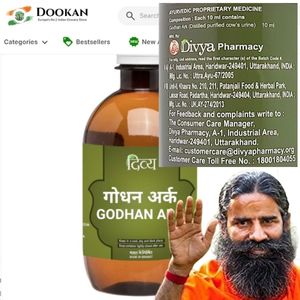
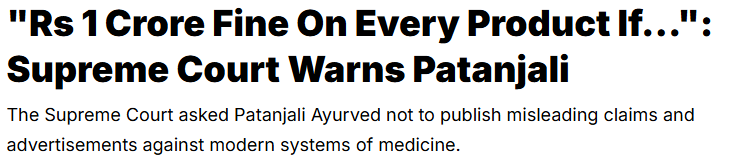
Recent legal developments in India, where the Supreme Court of India issued a stern warning to Patanjali Ayurved, the herbal products company co-founded by yoga guru Ramdev. In August 2022, the Court cautioned Patanjali against publishing false or misleading claims in advertisements that suggested its products could cure various diseases. The bench even indicated that a fine of up to Rs 1 crore (Approx 95,666 Euro) could be imposed on any product making such false claims. The ruling came after the Indian Medical Association (IMA) raised concerns over a smear campaign against modern medicine, including discouragement of vaccination drives and allopathic treatment. Click to read the news.
Despite these legal restrictions in India, Patanjali products continue to be widely available in international markets, including the United States, Canada, and multiple European countries. They are sold both through retail stores and online marketplaces. This raises questions about oversight and enforcement in jurisdictions outside India, where the company may still advertise or sell products with claims that are restricted or prohibited in its home country. The contrast underscores the challenges in regulating transnational commerce of herbal and Ayurvedic products and highlights the need for stricter monitoring to ensure consumer safety abroad.
Urgent Need for Enforcement Before Problems Escalate


The continued sale of cow urine in ethnic grocery shops is illegal, unsafe, and unregulated. It breaches EU import law, food-safety law, hygiene law, medicinal-product law, and customs law all at once. Luxembourg’s Customs – Excise agency and Veterinary and Food administration (ALVA) authorities have both the mandate and the tools to intervene swiftly- Seizure, destruction, fines, and prosecution against the accused. Given the scale of these violations, a coordinated investigation is not just justified, it is necessary to protect public health and uphold the integrity of Luxembourg’s food system. If imported animal fluids can enter unchecked, the door opens to far more dangerous materials.
Authorities should investigate immediately, seize the products, destroy them, and hold the importers accountable before a preventable problem becomes a public health issue.
Concerns Over Mislabeling, VAT Fraud, and Substandard Imports in Luxembourg’s Retail Sector
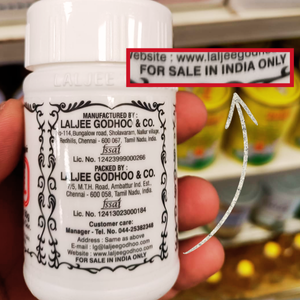
In addition to the illegal sale of cow urine in Indian grocery stores, there are numerous other issues in small grocery shops, including Indian, Nepali, Turkish, African, and other ethnic stores. For instance, exotic soaps imported from Syria are sold in Luxembourg with no proper labeling in any local language (labels are in arabic language). The VAT tax for these exotic soaps should be 17%, but many grocery store owners charge only 3%, and they often mislabel the products as simply “Lebensmittel” (food). This results in significant revenue loss for the government.
There are also perfume shops that claim to import perfumes from the UAE but provide no information about the producer or importer on the packaging. They engage in similar false invoicing, applying the wrong VAT rate (3% instead of 17%). This is happening widely throughout Luxembourg.
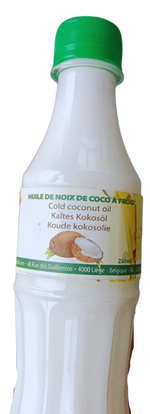
The Helvilux Investigative Team also discovered that in some African stores, coconut oil imported from Togo lacks proper certification. In many cases, these products are imported into Luxembourg through importing and marketing companies in Belgium or France.
Furthermore, there is a problem of misrepresentation on product packaging. In some reputed stores in Luxembourg, perfumes and beauty products imported from China are being sold with labels that falsely claim they are from the Netherlands or other EU countries. In very small print, it is indicated that the product is from the People’s Republic of China (P.R.C.), but this is not clearly visible to consumers.
Helvilux requested comments from the authorities regarding this matter. Customs and Excise agency and ALVA authority have since responded, confirming that an investigation has been initiated. We has also requested comments from Minister Gilles Roth of the Ministry of Finance, who oversees Luxembourg’s Customs and Excise Agency, regarding this matter. We will continue to monitor the situation and provide further updates as more information becomes available.