

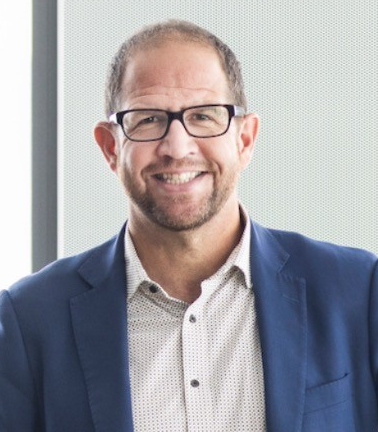
Luxembourg, (HELVILUX) — A heated online post by Mr. Jérôme Bloch, owner of 360Crossmedia, has reignited debate over the relevance of trade unions particularly the OGBL and LCGB in Luxembourg’s changing labour landscape. The post argues that unions have failed to evolve with the country’s economy, stuck in outdated paradigms and unable to respond strategically to modern challenges.
Mr. Bloch’s critique, shared widely on social media, paints unions as relics of an earlier industrial era. He suggests their methods and rhetoric are mismatched with Luxembourg’s current economic reality: a high‑productivity, finance‑driven economy under pressure from global competition and fiscal constraints.
Union Actions Under Scrutiny
Unions have indeed been active on multiple fronts, but each action carries mixed signals about their role and impact:
- Tripartite Dialogue Under Strain: Luxembourg’s traditional tripartite model, a structured negotiation framework involving government, unions, and employers has fractured. In late 2025, OGBL president Nora Back and LCGB publicly announced that unions would no longer participate in broad labour and employment committee negotiations, citing their marginalisation in decision‑making.
- Unions Still Mobilising: Despite rhetoric about irrelevance, unions have continued organising and challenging government policies, including leading large protests and joint letters to the prime minister on issues such as poverty strategy.
- Union Collaboration: OGBL and LCGB have also formalised a collaborative structure to defend workers’ rights, demonstrating an attempt at strategic unity.
These activities suggest unions are still operational, yet critics like Mr. Bloch argue their influence is reactive opposing reforms or government action, rather than forward‑looking and constructive.
Steel Industry Shake‑Up: A Test for Unions
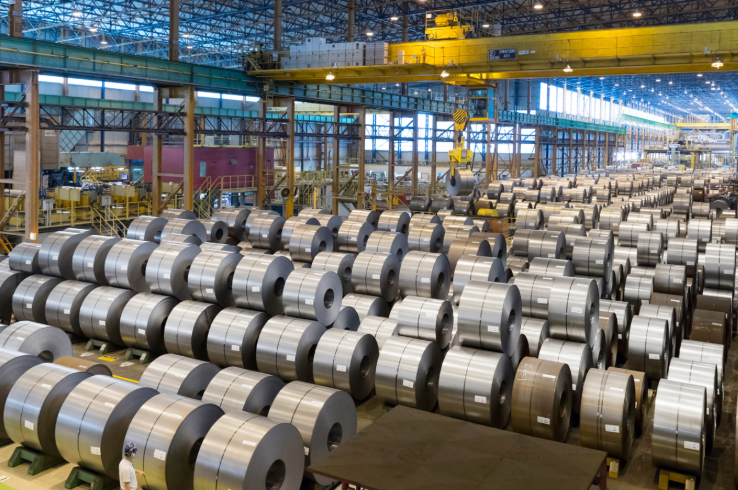
Nowhere is this debate more acute than in the steel sector, historically a union stronghold and symbolic anchor of Luxembourg’s industrial past.
Recent reports indicate that global steel giant ArcelorMittal is considering relocating support‑function roles, potentially including as many as 1,150 jobs from Luxembourg to lower‑cost locations such as India and Poland.
Unions have pushed for urgent discussions with political leaders, even calling for renewed tripartite meetings specifically on the steel industry’s future. Meanwhile, the government has signalled it does not see an urgent need for such a meeting, although officials maintain ongoing dialogue and stress they oppose unilateral relocations.
This situation places unions in a difficult spotlight: they must balance defending jobs and resisting relocations, while also responding to global competitive pressures that companies cite as drivers of restructuring.
A Broader Question: Evolve or Oppose?

Mr. Bloch’s central thesis that unions cling to outdated frames like a “steel industry victims vs. bosses” narrative resonates with some observers who argue that Luxembourg’s economy has shifted dramatically since syndicalist origins. But union leaders counter that their role remains vital in protecting workers amid structural shifts, including major layoffs at Amazon and restructuring at ING Luxembourg where unions negotiated social plans to soften workforce impacts.
Whether unions can reinvent themselves as proactive social partners, contributing to policy development and strategic planning, rather than simply resisting reform – remains an open question. For now, public and political debates about their relevance are intensifying, with the ArcelorMittal situation serving as a potential turning point.
Regarding this, Helvilux contacted OGBL to understand their side of the story, but until publication, they did not provide any response. Once they provide a response, it will also be published for readers.
Online Petition for Transparency and Accountability
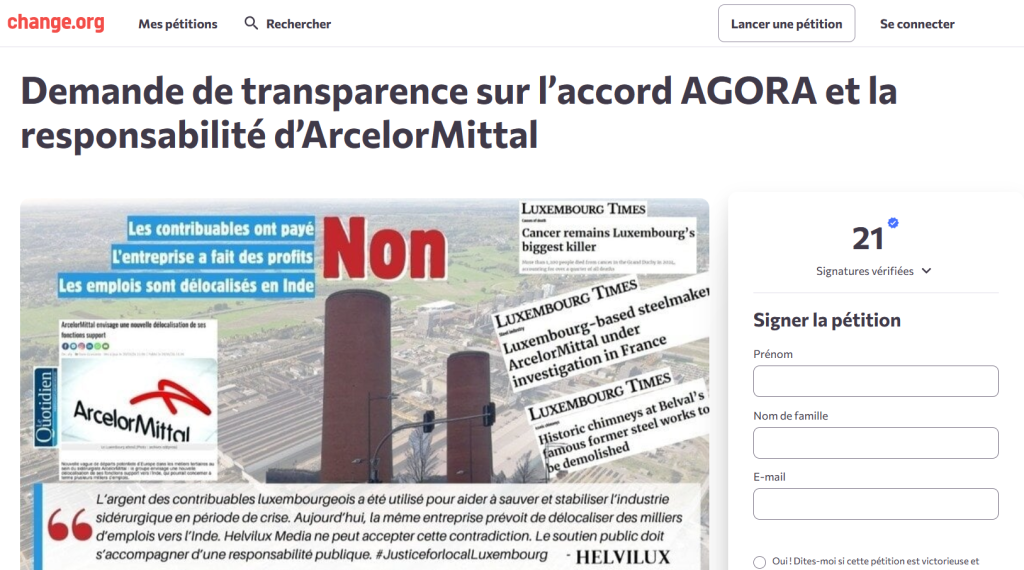
Helvilux media recently started an online petition demanding full transparency regarding ArcelorMittal’s long-term responsibilities toward Luxembourg. Citizens are asking for the publication of all contractual obligations, a breakdown of public funds invested and guarantees that public support is tied to employment protection and environmental accountability. Luxembourg taxpayers helped stabilize the steel industry during difficult times. The company returned to profitability. Yet jobs are now being considered for relocation to India. Public support must come with public responsibility. Residents who believe in transparency, fairness, and accountability can sign the petition online and make their voices heard. Click here to sign
Helvilux does not receive any subsidies or financial assistance from the governments of Luxembourg or Switzerland to support its journalism work. HELVILUX Media is an independent media outlet run by the non-profit organization Helvilux asbl in Luxembourg. To support our work with a donation, click here.