Luxembourg (Helvilux)- Pirate Party Deputy Marc Goergen has once again positioned himself as a vocal critic of nuclear energy, labeling it a “fairy tale” of affordability while championing renewables as the safer, more competitive alternative. The 24-second video, titled “Aal Atomkraaftwierker – fort domadder!” (“Old Nuclear Power Plants – Away with Them!”), echoes long-standing concerns in Luxembourg about the hidden costs and risks of atomic power, amid ongoing EU-wide debates on energy policy.
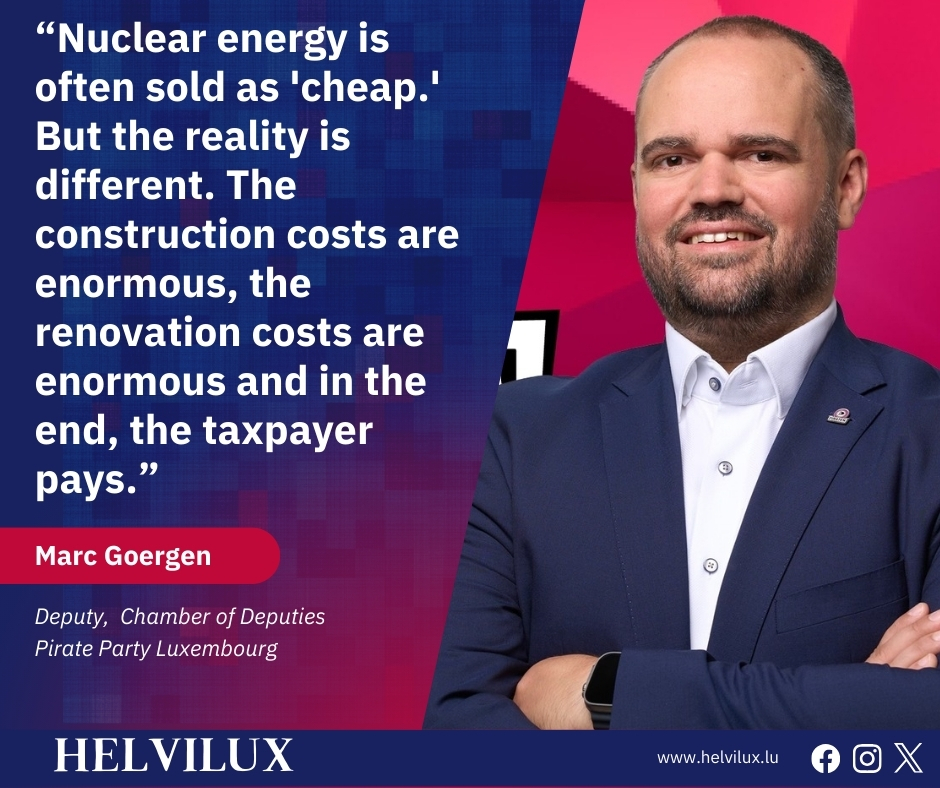
Goergen, a prominent figure in Luxembourg’s Pirate Party (Piraten) and a deputy in the Chamber of Deputies, delivers his message in Luxembourgish, highlighting the enormous construction and renovation expenses associated with nuclear plants. “Atomenergie gëtt dacks als ‘bëlleg’ verkaaft. Mee d’Realitéit ass eng aner: D’Baukäschten sinn enorm, d’Renovationskäschten sinn enorm -an um Enn bezilt de Steierzueler,” he states: “Nuclear energy is often sold as ‘cheap.’ But the reality is different: The construction costs are enormous, the renovation costs are enormous and in the end, the taxpayer pays.” He dismisses the notion of “cheap nuclear power” as a myth, warning of “tremendous risks for humanity” and criticizing state investments in nuclear as public money rather than market-driven prices.
The statement align with the Pirate Party’s emphasis on transparency, environmental justice and innovation in energy. Goergen’s stance is consistent with his previous interventions, such as questioning the government on energy prices and green alternatives, including solar parks along motorways.
Luxembourg, which has no nuclear power plants and relies heavily on imported energy, has long opposed atomic expansion. In a recent parliamentary debate in October 2025, there was broad agreement across parties that “nuclear energy is not the future,” with CSV’s Marc Boonen assuring no plants would be built under the current government. This reflects the Grand Duchy’s focus on renewables and efficiency, evidenced by the extension of €150 million in energy subsidies into 2026 to lower grid charges for households and businesses. Economy Minister Lex Delles has emphasized that these measures will reduce electricity bills for all users starting January 2026, prioritizing sustainable sources over fossils or nuclear.
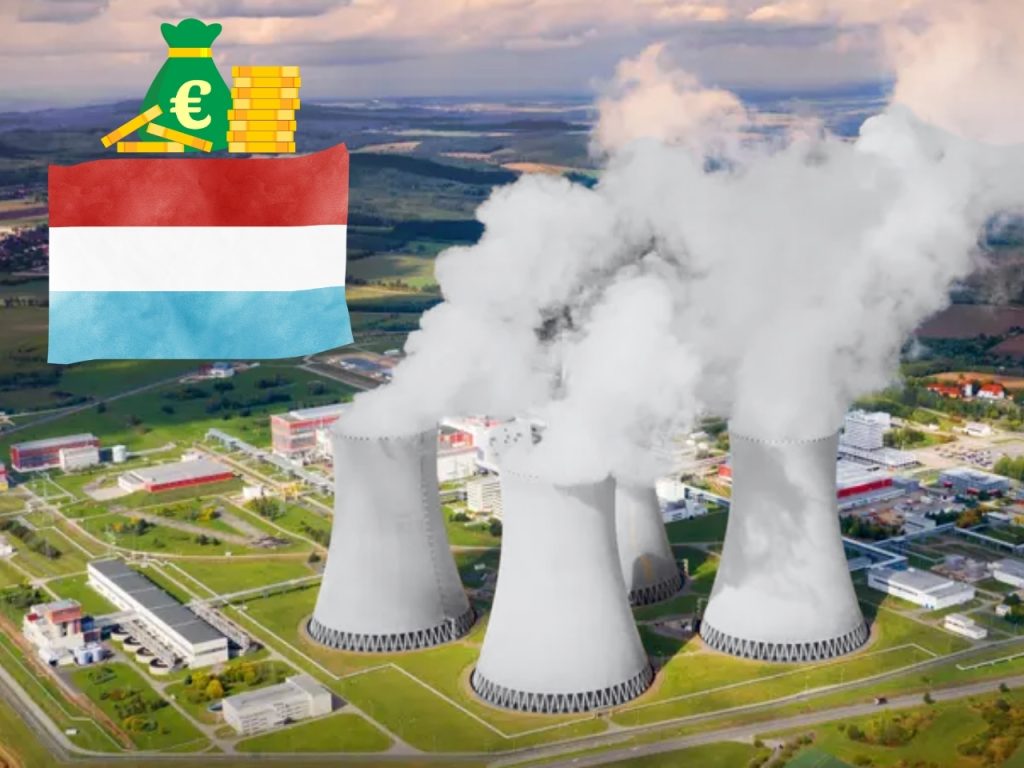
Goergen’s critique comes at a pivotal time for EU energy policy. The European Commission estimates €241 billion in investments needed for nuclear by 2050 to support decarbonization, including life extensions and new builds. Nuclear capacity is projected to rise from 98 GWe in 2025 to 109 GWe by 2050. However, Luxembourg, alongside Austria, has challenged the EU’s classification of nuclear as “sustainable” under the Taxonomy Regulation. In September 2025, the EU General Court upheld the inclusion of nuclear and natural gas as transitional sustainable activities, dismissing Austria’s (and Luxembourg’s supported) case, arguing the Commission did not exceed its authority. Pro-nuclear nations like France, Hungary, and Poland backed the ruling, viewing atomic power as essential for energy security and low-carbon goals.
Critics like Goergen point to unresolved issues, such as radioactive waste management and dependency on Russian technology concerns echoed in EU reports. High costs remain a flashpoint: Nuclear projects often face delays, with levelized costs ranging from $110-221/MWh, compared to declining renewables at $24-96/MWh. Yet, proponents argue nuclear provides reliable baseload power, with low lifecycle emissions and a death rate of just 0.03 per TWh, comparable to wind and solar.
In Luxembourg, where energy policy emphasizes renewables and electrification for security, Goergen’s reel taps into public sentiment favoring green transitions. As the EU pushes for 82% clean energy by 2030, with some nations accelerating fossil phase-outs, the divide persists. Goergen, in a 2024 interview, stressed supporting greener alternatives amid cost-of-living pressures, urging the government to avoid overwhelming residents with outdated energy models.
While the Goergen view be dismissed by nuclear advocates as alarmist, it underscores Luxembourg’s commitment to a nuclear-free future. As debates rage in Brussels, voices like Goergen’s remind us that energy choices are not just technical but deeply tied to fairness, sustainability and taxpayer accountability. With Poland planning its first reactor by 2033 and Sweden eyeing expansions, Luxembourg’s stance could influence smaller nations in the “friends of renewables” bloc.
Helvilux does not receive any subsidies or financial assistance from the governments of Luxembourg or Switzerland to support its journalism work. HELVILUX Media is an independent media outlet run by the non-profit organization Helvilux asbl in Luxembourg. To support our work with a donation, click here.