
…And it came to pass in the land of institutions that men and women wrote rules, and then discovered they, too, must read them.
Lausanne (Helvilux) – In the Bible, John 8:32 states: “And you shall know the truth, and the truth shall make you free.” After looking into the romantic relationship between two sitting judges of the highest court, the Federal Supreme Court in Lausanne, one thing becomes clear: the truth cannot be hidden and when it’s known it makes you free.
Over the years, concerns have been raised about the Swiss Federal Supreme Court’s decisions in several appeals, where some applicants, instead of receiving justice, were given substantial costs from 1500 CHF to 2000 CHF to pay following the dismissal of their cases. In several instances, the European Court of Human Rights has criticized rulings of the Swiss highest court. This series of events has been seen by some as a warning sign that something may be wrong within one of the world’s most respected judicial institutions.
On 30 April 2026, the weekly Die Weltwoche published an article about a romantic relationship between Federal Judge Beatrice van de Graaf and Federal Judge Yves Donzallaz. This once again sparked debate and led some observers to argue that Switzerland’s judiciary system may require reform.
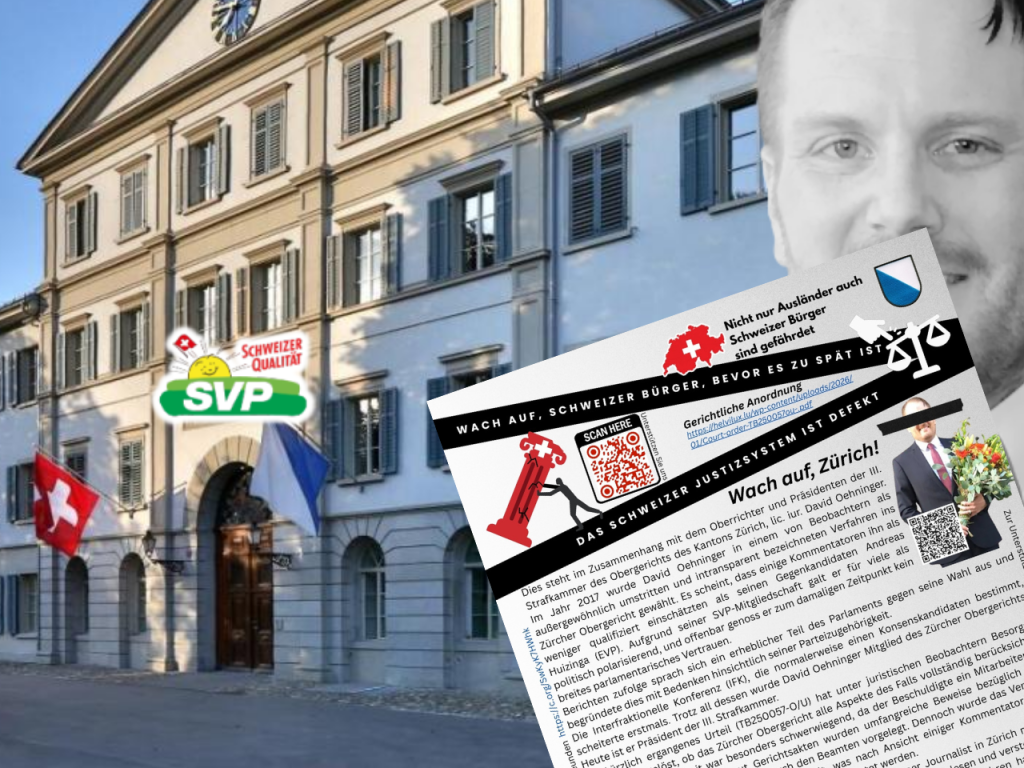
Helvilux Media reported some months ago on the situation within the Swiss judiciary at the Zurich cantonal level, where obtaining justice is reportedly very difficult for victims, particularly in cases involving alleged misconduct by police officers. Click here to read.
A particular judge and president of a chamber, who is also affiliated with the SVP political party, is accused by critics of not properly engaging in fact-finding. According to these concerns, when the accused party is a police official accused of office abuse the judge tends to focus primarily on the state’s position rather than thoroughly examining the facts presented by the victim, who is an ordinary citizen and resident of city Zurich.
Following the publication of Helvilux Media’s article, the Cantonal Court of Zurich and other cantonal courts reportedly improved their websites, which has been seen by some as a small but positive sign that judicial reforms may be taking place at the cantonal level in Zurich.
Now, the situation involving Yves Donzallaz and van de Graaf has further intensified discussions and, in the view of some observers, highlights the need for judicial reform at the federal level within the Swiss Federal Supreme Court.
After the publication of the news, both judges reportedly informed the court that their romantic relationship had ended. However, whether this ended independently or as a result of media exposure and internal scrutiny is known only to the individuals involved.
The alleged relationship between Judge van de Graaf and Judge Yves Donzallaz has become a subject of public controversy within the history of the Swiss Federal Supreme Court in Lausanne, as such cases are extremely rare in the institution.
Former SVP National Councillor and journalist Christoph Mörgeli made the story public in Die Weltwoche. It is also noted that Judge van de Graaf is associated with the SVP, while Yves Donzallaz was previously linked to the same SVP party but later became independent. Mörgeli is also a former SVP National Councillor.
Some commentators have referenced biblical passages, including Matthew 10:36:
“A man’s enemies will be the members of his own household.”
Public opinion in Switzerland appears divided. Some argue that political background and previous party conflicts may influence how the situation is interpreted, particularly given that Yves Donzallaz has issued rulings that were not always in line with SVP positions.
Others maintain that, regardless of political context, the central issue is whether the relationship could fall under the definition of a “permanent domestic partnership” under Article 8 of the Swiss Federal Supreme Court Act (Bundesgerichtsgesetz, BGG), and whether this could raise questions regarding judicial compliance and institutional integrity.
At this stage, the situation remains under discussion, and no official legal determination has been publicly confirmed regarding a violation.
The alleged relationship between Federal Judges van de Graaf and Yves Donzallaz, which has been reported in the media, has raised questions about the strength and authority of the Swiss Federal Supreme Court’s internal rules. Some observers argue that the case will test whether the court fully upholds its own legal standards under the Swiss Federal Supreme Court Act, or whether situations involving judges themselves could challenge public confidence in judicial impartiality.
Public attention in Switzerland is focused on the upcoming decision expected at the end of June.
An independent panel of experts has been appointed to examine the case. An external expert is expected to clarify the facts surrounding the matter involving Federal Judges van de Graaf and Donzallaz and report back to the Administrative Commission of the Federal Supreme Court. The court stated in writing on Friday that the findings are expected by the end of June, after which a decision will be made on how to proceed.
The affair has already triggered political reactions in Bern, particularly from the SVP. National Councillor Pascal Schmid (SVP, Thurgau) told CH Media that there are indications of a potentially impermissible situation. If this is confirmed, he stated that resignation would be unavoidable. He also warned that the credibility of the judiciary could suffer significantly if federal judges fail to comply with the applicable rules.
It is also a practical and general situation that romantic relationships between members of the staff in the same government official are generally considered incompatible with the customary standards of conduct, regardless of individual cases.
These standards require members to avoid any behaviour that could call into question their independence or damage the reputation of the government offices. Now with respect to Swiss constitution of Equality before law that same be applicable to Swiss court is what is demanded by many Swiss citizens.
On social media, two main groups have emerged. One group supports the judges’ alleged relationship, arguing that it should be viewed as a private matter and that Article 8 of the Swiss Federal Supreme Court Act is being misinterpreted. The other group is calling for both judges to resign and criticising what they see as attempts to downplay or justify the situation.
Some supporters of the relationship argue that critics are unfairly turning the matter into a scandal. Others, however, maintain that some of the same individuals defending the relationship have previously expressed frustration when their legal appeals were arbitrarily dismissed, even in cases where they believed the evidence was in their favour. Some argue that this reflects a broader lack of trust in, and understanding of, how the Swiss judicial system operates.
There is also debate about the interpretation of Article 8, particularly the term “permanent domestic partnership” or “stable life partnership.” Some argue that the provision does not apply in this case. Others counter that even outside formal legal definitions, romantic relationships between judges working within the same institution may raise concerns about conflicts of interest or perceived bias, particularly at the level of the Swiss Federal Supreme Court (National last domestic remedy court).
As per court, On Wednesday, 13 May 2026, an extraordinary plenary session will also be held regarding further aspects related to the relationship of the two members of the Court. Through these decisions, the Administrative Commission aims to contribute to a rapid, independent and transparent clarification of the specific case while also addressing, from a forward-looking perspective, the issues raised by this matter.
According to their statements, their relationship began only after the end of their mandates within the Administrative Commission, of which they were members in 2023 and 2024, with Federal Judge Donzallaz serving and Federal Judge van de Graaf joint service. According to the statements of those involved, the relationship had already ended before the publication of the article in the weekly Die Weltwoche.
Also court stated that, The independence of the Federal Supreme Court in the exercise of its judicial functions is a central element of the Swiss rule of law and must be guaranteed at all levels. For this reason, the Administrative Commission decided last Monday to appoint a panel of experts, consisting of one woman and one man, to clarify the facts independently. The appointed external experts are Ms Maya Hertig, Professor at the Faculty of Law of the University of Geneva, and Mr Jean-François Meylan, former President of the Vaud Cantonal Court. On Tuesday, the Judicial Commission as well as the sub-commissions for Courts / Office of the Attorney General of the Confederation of the Supervisory Committees were informed of this procedure.
The case is considered sensitive for another reason: if it were determined that the rules regarding the composition of the court were violated, parties in previous cases could potentially seek a revision of judgments. Whether this would apply in practice depends on the legal assessment of whether an impermissible situation existed.
If it is ultimately concluded that no violation of Article 8 occurred, some commentators argue that this may lead to renewed calls to clarify or expand the rule. Such proposals could include not only “permanent domestic partnerships” or “stable life partnerships,” but also clearer guidelines on romantic relationships between judges, in order to further safeguard institutional integrity and public confidence in the Federal Supreme Court.
Once upon a time, the world remembered lovers like Romeo and Juliet because they were ready to lose everything for love. Now, Switzerland may have produced a more modern version of romance at the Swiss Federal Supreme Court where, according to critics, love appears to survive only until the newspapers arrive. Unlike Romeo and Juliet, who died for love, this story, some sarcastically remark, seems to show a love that died to save two chairs at the Federal Supreme Court.
Both Federal Judges van de Graaf and Donzallaz have not publicly commented on the matter.